
An Early-Stage Founder Operating System
0 → 1 → First Multiplier (B2B SaaS)

This piece is for very early-stage B2B SaaS founders.
Specifically:
before you have 5 real ICP clients
before your product feels “obvious”
before systems exist
before growth is predictable
This is not a growth playbook.
This does not apply to hard tech, deep R&D, or post-PMF companies.
Most founders fail not because they lack effort, but because they apply the right ideas at the wrong stage. This memo exists to prevent that.
The goal here is simple:
Help founders make better decisions in the messy pre-scale phase by giving them a simple operating system.
If something does not increase learning velocity or decision quality, it does not belong here.
1. The Only Objective Early Stage: Learning Velocity
Early stage is not about optimization.
It is not about scale.
It is not even about growth.
It is about learning faster than you burn time, energy, credibility (and $$$).
At this stage:
leads can lie
revenue can lie
partnerships can lie
enthusiasm can lie
The founder’s real job is discrimination:
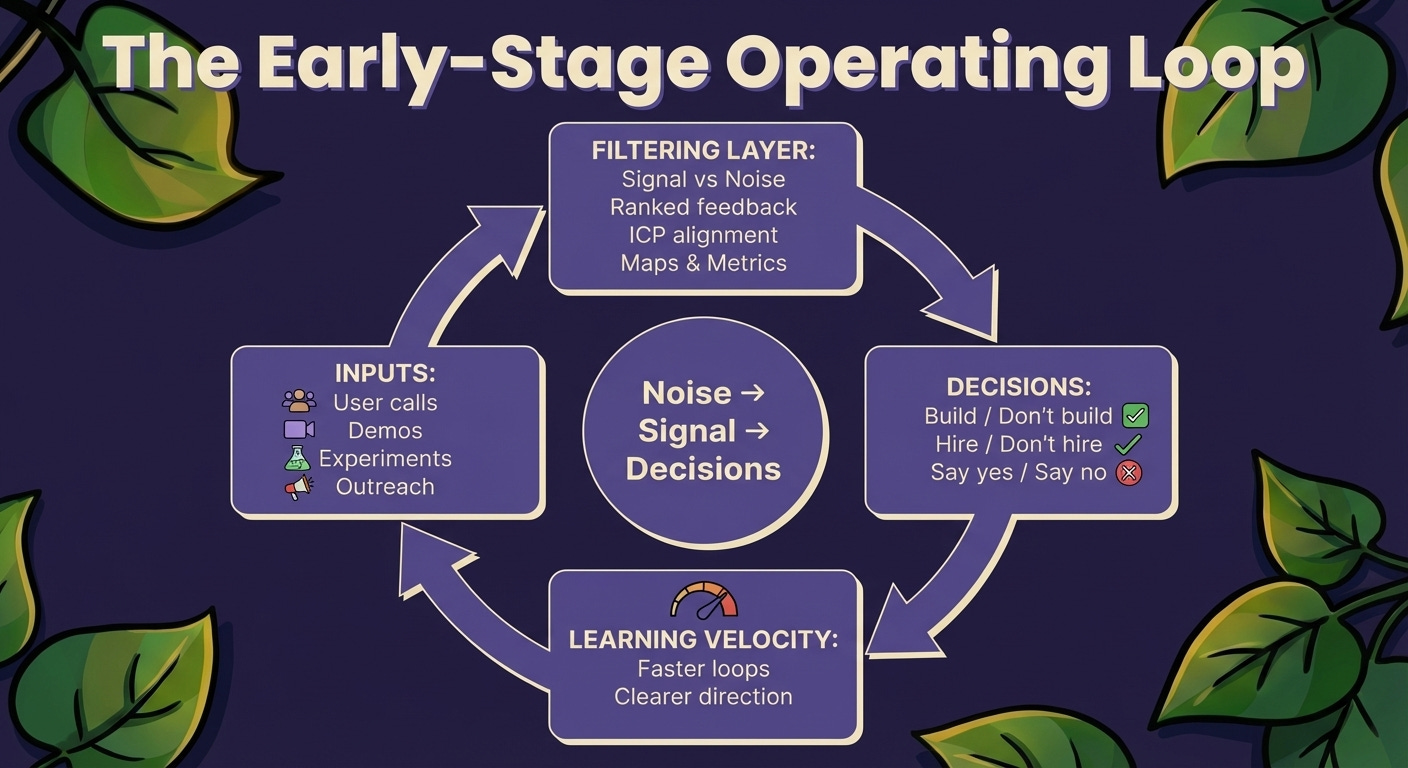
signal vs noise
leverage vs distraction
learning vs activity theater
This is why first-principles thinking matters. Rules are useful only if you know when they apply. Early stage is mostly about knowing when they don’t.
2. Converting User Calls Into Signal (Mission & ICP Iteration)
User calls are your highest-leverage input early.
But only if treated correctly.
Volume first, judgment second
You need enough volume to see patterns.
calls
demos
conversations
feedback loops
There is no universal number, but if you’re debating whether to build or talk to users, the answer is usually: talk more.
Not all user calls are equal
Feedback must be ranked, not averaged.
High-quality signals usually come from:
users who are smart
users who already use alternatives deeply
users who can articulate tradeoffs
users who care about improvement, not novelty
Low-quality signals:
users far from your mission
users describing problems already solved by existing tools
users who don’t understand the space
users pulling you sideways instead of forward
Do more calls with the first group.
Do fewer with the second.
Use calls to reinforce (or challenge) mission & ICP
Calls are not just for feature discovery.
They are for directional alignment.
At some point, you want:
all calls
transcripts
notes
tags
in one place, so patterns compound over time.
This does not need to be over-engineered.
A lightweight system becomes valuable when:
more than one person is doing calls
context no longer fits in the founder’s head
the first sales hire joins
Say no early (and explain exceptions loudly)
Do not fear closing or firing a client that:
is far from your ICP
consumes disproportionate resources
adds friction without strategic value
Sometimes you will take a bad-fit client for cash or survival. That is fine.
What matters is this:
call it an exception
explain why
make it clear this is not the future
If you don’t, your team will draw the wrong conclusions.
3. What “Data-Driven” Actually Means Early Stage
Early-stage founders often say they are data-driven.
Most are not.
They confuse rigor with premature optimization.
Explicit rule: no A/B testing
A/B testing assumes:
stable systems
sufficient volume
known baselines
You have none of those.
Running A/B tests early creates the illusion of progress while slowing learning.
A different definition of data-driven
Being data-driven early means:
tracking progress, not precision
direction over certainty
visibility over optimization
INPUTS and OUTPUTS
having maps of how we do things
Manual data is fine. Directional data is enough.
4. Inputs First, Outputs Later
Early stage often looks like this:
massive effort
minimal results
That does not mean nothing is happening.
If outputs lag, you must make inputs visible.
Examples:
number of user calls
number of demos
number of outbound attempts
number of experiments shipped
number of interviews run
number of candidates sourced
Tracking inputs:
creates accountability
reduces panic
shows where effort is going
allows tuning instead of guessing
This does not mean doubling your workload to track everything.
It means:
measure what is easy
measure what moves learning
ignore the rest
This applies to every function:
sales, marketing, product, hiring, ops, finance, design, engineering.
5. Building the Map: Metrics as Decision Infrastructure
Early stage feels chaotic because the ship moves left and right.
Chaos is normal.
Blindness is not.
Simple metrics create a map.
The rule
Every area should report:
WoW
MoM
Using:
very few metrics (2–3 max)
mostly inputs
some key outputs when available
This is not about performance theater.
It is an accountability and visibility system.
Why this matters
Simple metrics:
reveal patterns
improve decision quality
increase predictability
prepare the company to scale
Metrics are the surface of reality.
They give CEOs and leaders signal instead of intuition.
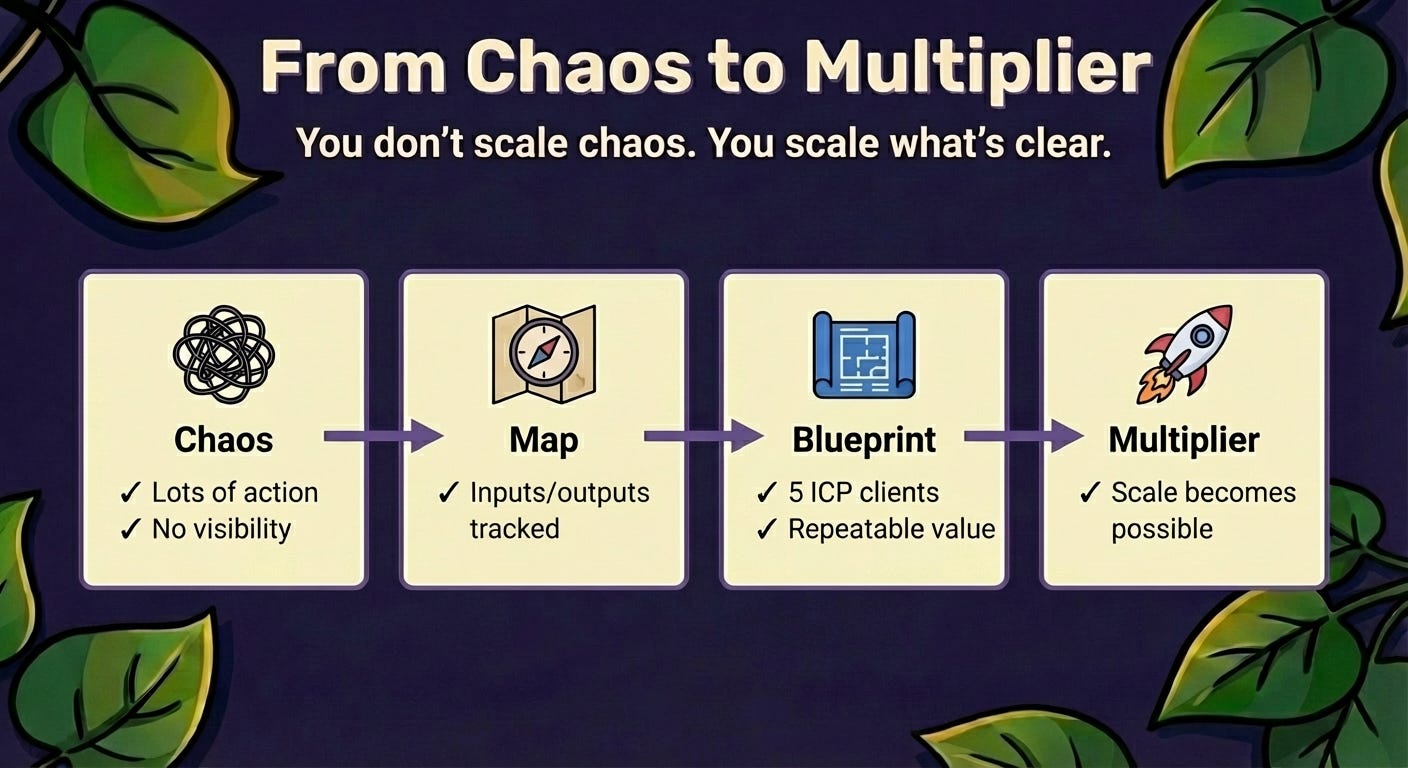
6. From Chaos to Blueprint (0 → 1)
This is where the real transition happens.
When:
metrics exist
systems exist
learning compounds
you start building a blueprint.
The most important milestone:
5 delighted clients that are your exact ICP
This is similar to the Forward Deployed Engineer idea:
deep engagement
real value
repeatable success
This is the moment:
direction stabilizes
systems harden
the first multiplier becomes possible (5 → 50)
You do not scale chaos.
You scale what already works.
7. Resource Allocation Without Politics (Hiring & Clients)
As capital enters the business—via revenue or funding—you still cannot do everything.
This is where most companies break.
Hiring is a leverage decision
Early hiring should answer:
what system does this unlock?
what bottleneck does this remove?
what leverage does this create?
Without systems and metrics, hiring decisions default to:
who complains the loudest
who feels most urgent
That is how companies lose.
The correct sequence
When asking for resources:
explain how the system works today
show metrics and capacity
show what exists to improve efficiency
explain why this hire is highest leverage now
This creates a culture that rewards:
clarity
leverage
company-level thinking
The same logic applies to clients that bring cash but pull you off-mission. Conscious tradeoffs are fine. Unconscious ones are dangerous.
8. Founder Doctrine (Memorize This)
Move fast, but don’t optimize
Learning velocity > growth
Measure inputs before outputs
Build systems before scale
Reward leverage, not noise
Know your stage at all times
No A/B testing
This is not about control.
It is about direction.
Early stage is messy by nature.
The goal is not to remove chaos.
The goal is to see clearly while moving fast.
That is my operating system.
Didnt expect such a clear framework for early-stage! Focusing on learning velocity is incredibly smart. It makes me think how much psychological safety in a team also fuels that signal vs noise discrimination. Such a helpful piece, thank you!