
The 7 Powers Framework Revisited: Building AI Moats in 2025
A classic strategy book gets an AI upgrade - and the insights are pure gold

The 7 Powers Framework Revisited: Building AI Moats in 2025
A classic strategy book gets an AI upgrade—and the insights are pure gold
I recently listened to the Lightcone podcast dissect Hamilton Helmer’s “7 Powers” through the lens of modern AI startups, and it was one of those rare moments where timeless strategy meets bleeding-edge reality. If you haven’t read the original book, it’s a classic for a reason - Bloomberg even named it one of the best books of 2017. But hearing how these principles translate to 2025’s AI landscape? That’s where things get interesting.
The Hidden Power (Power Zero): Speed
Before we dive into the seven powers, the hosts make a crucial point that every founder needs to tattoo on their brain: you don’t need a moat until you have something worth defending.
“A moat is inherently a defensive thing and you have to have something to defend... if you got nothing to defend, don’t worry about your moat.”
The real power at the early stage? Speed. Find someone with an existential problem—the kind where they might get fired if it’s not solved—and fix it. Fast. The moats come later.
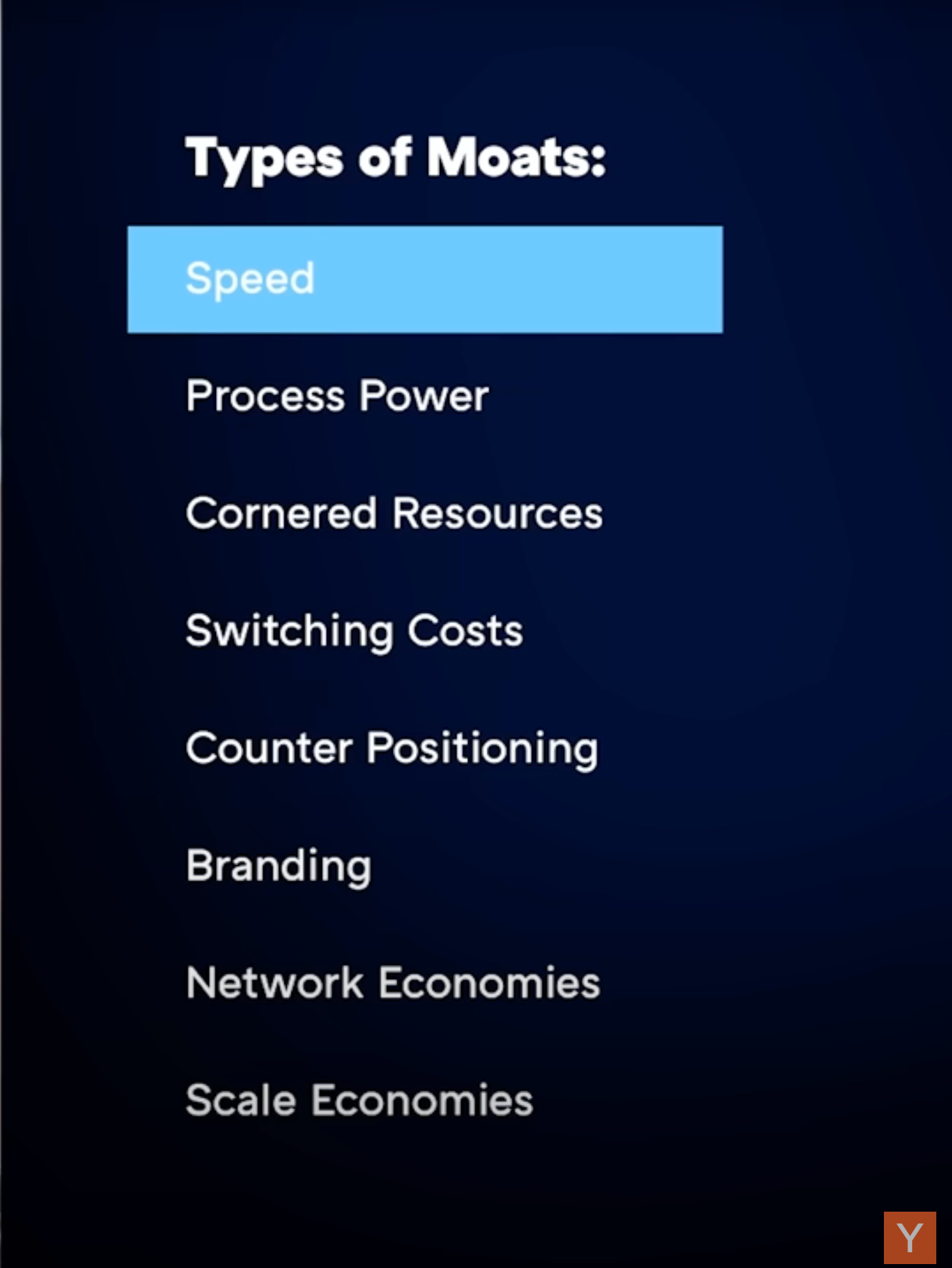
1. Process Power: The 99% Solution
lex and refined that competitors can’t replicate it.
AI twist: Anyone can build a ChatGPT wrapper demo in a weekend. The real moat is in achieving 99% accuracy in production for mission-critical tasks - KYC for banks, loan origination, compliance checks. That last 1% requires years of unglamorous edge-case engineering that most people (including big lab teams) don’t want to do.
Questions to ask yourself:
Where does my product need to be boring and perfect? What’s the difference between a demo and a production system in my domain?
What edge cases would take a competitor 2+ years to discover and fix? Can I catalog and solve these systematically?
Am I willing to do the unglamorous work? If my product requires 99% reliability, do I have the patience for the drudgery of getting from 80% to 99%?
Companies doing this: CaseText, Greenlight, Causa, Plaid
2. Cornered Resources: The Diamond Mine in Your Customer’s Head
What it is: Controlling a coveted asset competitors can’t access.
AI twist: Forget traditional IP. The real cornered resource is proprietary understanding of customer workflows. By becoming a “forward deployed engineer” (more on this below), you gain access to the boring, specific, undocumented internal processes that make businesses run. This knowledge becomes custom prompts, evaluation sets, and fine-tuned models that no competitor can replicate.
Questions to ask yourself:
What boring internal process do my customers understand that no one else does? Can I become the expert in translating this to AI?
What data am I generating with customers that compounds in value? How can each deployment make the next one easier?
Am I close enough to see the diamond mine? Do I actually understand my customer’s workflow, or am I guessing from the outside?
Companies doing this: Scale AI, Palantir, Character.ai
A note on Forward Deployed Engineers
The term “forward deployed engineer” appears throughout the podcast for good reason. If you’re not familiar with this role, check out these two excellent pieces:
The core insight: you’re not just building software, you’re embedding with customers to become an extension of their team. Lower margins now, massive moat later.
3. Switching Costs: The Double-Edged Sword
What it is: Making it painful for customers to leave.
AI twist: This one’s fascinating because AI both destroys and creates switching costs. LLMs can help customers migrate away from legacy systems. But once you’ve spent 6-12 months customizing an AI agent’s logic for a specific enterprise workflow? Good luck convincing them to do that again with a competitor. For consumers, it’s about memory—the AI that knows you is hard to abandon.
Questions to ask yourself:
What customization work do I do that took months of painful iteration? Would a customer really want to repeat that process?
What does my AI “remember” that makes it irreplaceable? Is this defensible, or could a competitor import/replicate it?
Am I building genuine lock-in or just friction? (One creates value, the other creates resentment)
Companies doing this: Happy Robot, Salient
4. Counter Positioning: The Innovator’s Dilemma Strikes Again
What it is: Adopting a business model incumbents can’t copy without destroying themselves.
AI twist: Two powerful forms emerge:
Pricing disruption: New AI companies charge per task or value delivered. Legacy SaaS companies are trapped with per-seat pricing. If their AI works well, it reduces seats and cannibalize their revenue.
Product focus: You can counter-position against early AI winners who made premature technical bets (like over-investing in fine-tuning when few-shot prompting is now often sufficient).
Questions to ask yourself:
What does my competitor make money doing that my product makes obsolete? Can they adopt my model without killing their business?
What revenue stream am I destroying? Is it their main one, or a side business they’d happily kill?
Where did the first movers over-optimize? What technical or go-to-market assumptions have changed since they made their bet?
Companies doing this: Avoka (vs ServiceTitan), Legora (vs Harvey), GigaML (vs Sierra), Speak (vs Duolingo)
5. Network Economies: The Data Flywheel
What it is: The product gets better as more people use it.
AI twist: Classic network effects still matter, but the AI version is all about the data flywheel. More users → more data → better models (via training, RLHF, evals) → better product → more users. OpenAI does this with chat history. Cursor does it with every keystroke in their free tier.
Questions to ask yourself:
What data from each user makes the product better for all users? Is this a genuine flywheel or just a data collection exercise?
Can I create a public/community layer? Where does the network effect get strongest?
How quickly does my model improve with data? Do I have the infrastructure to rapidly retrain and ship improvements?
Companies doing this: OpenAI (GPT improvements), Cursor (code autocomplete)
6. Scale Economies: The Billion-Dollar Barrier
What it is: High fixed costs that only make sense at scale.
AI twist: This moat lives almost exclusively at the foundation model layer. Training frontier LLMs requires capital most startups can’t access. At the application layer, a few companies are building this by investing heavily upfront to crawl massive portions of the web, then offering that as search infrastructure to other AI companies.
Questions to ask yourself:
Am I realistically competing at the scale layer? (Probably not, unless you have a $100M+ war chest)
Can I build infrastructure that amortizes across many customers? What’s my version of “crawl the web once, sell access to many”?
Where can I leverage someone else’s scale economies? What foundation models or infrastructure can I build on rather than recreate?
Companies doing this: OpenAI, Google, Anthropic (models); Exa.ai (search infrastructure)
7. Brand: The ChatGPT Phenomenon
What it is: Customers choose you simply because they know and trust your name.
AI twist: Brand is nearly impossible for startups to build quickly, but the ChatGPT story is stunning. OpenAI’s ChatGPT has more daily users than Google’s Gemini, despite Google’s massive existing user base and arguably equivalent technology. How? Speed to market + focus = the defining consumer AI brand.
Questions to ask yourself:
Am I building a category-defining product? Can I be first/best enough to become the generic term? (Like “Google it” or “ChatGPT for X”)
What’s my distribution moat if I can’t win on brand? How will customers discover me against entrenched players?
Can I build brand through content/community first? What’s my path to mindshare before I have market share?
The ultimate example: OpenAI/ChatGPT
Bringing It All Together
I revisit the 7 Powers framework constantly, but this podcast reminded me that the real art is knowing when to think about moats. Not at the beginning. Not when you’re trying to find product-market fit.
Only once you’ve built something valuable. Only once there’s treasure to defend.
Until then? The only power that matters is speed. (you still need to think about the powers to help your decision making of course)
Now I want to hear from you: Which of these powers feels most applicable to what you’re building? And more importantly—are you moving fast enough that you don’t need to worry about moats yet?
What’s your take on the 7 Powers in the AI era? Reply or share your thoughts—I’d love to hear how you’re thinking about defensibility in your startup.